
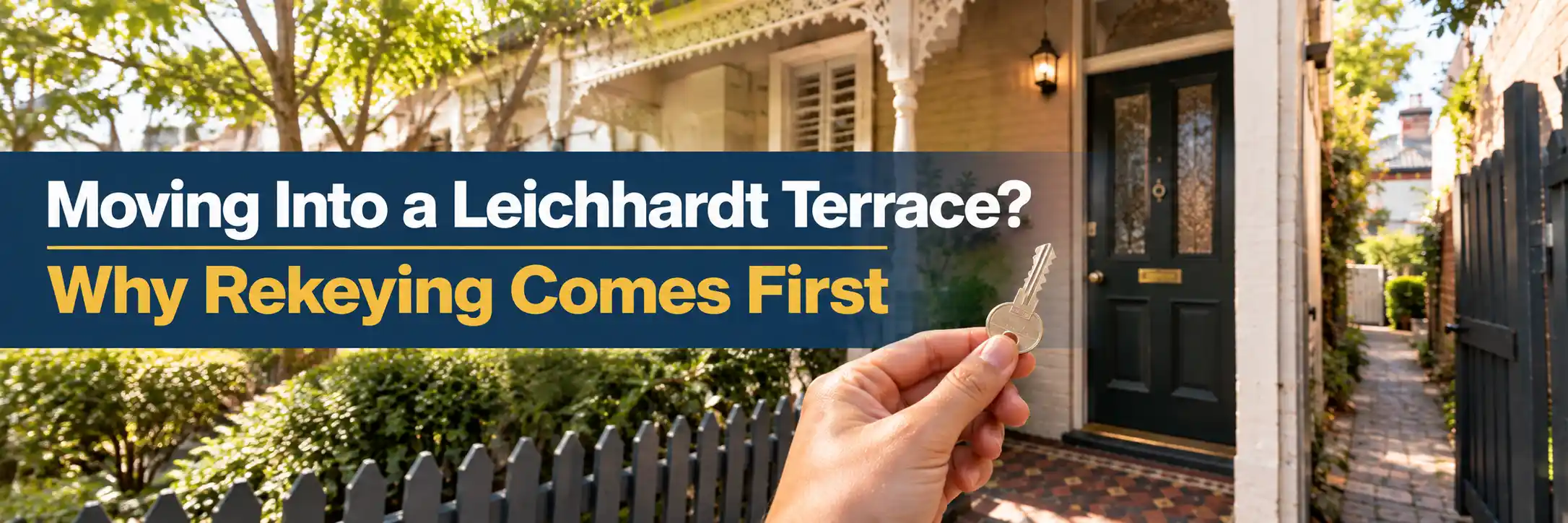
Leichhardt’s terrace homes — the federation and Edwardian terraces that line the suburb’s residential streets behind Norton Street, the full brick semis with high ceilings and polished timber floors — are among the Inner West’s most sought-after properties. At a median house price approaching two million dollars, moving into a Leichhardt terrace is a significant commitment. The security action that should precede unpacking, painting, and renovating is also the simplest: rekeying Leichhardt terrace properties before the first night of occupancy closes a key history that the previous occupants couldn’t fully account for even if they tried.
What a Leichhardt Terrace Key History Actually Looks Like
Leichhardt’s residential streets have a community character that reflects the suburb’s tight-knit nature — long-term residents, neighbours who know each other, the kind of community where people genuinely look out for each other’s properties. This same character creates a specific key history pattern. A Leichhardt terrace that’s been owner-occupied for fifteen years by a family embedded in the Italian-heritage community may have distributed keys to:
- Extended family members who helped with children or pets
- Long-term neighbours given emergency access over years of mutual trust
- Tradespeople engaged across multiple renovation projects — Leichhardt’s period homes are frequently updated, and each project brings multiple keyholders
- A cleaner who came weekly for a decade
- Real estate agents during the sales campaign, which in Leichhardt’s competitive market can involve months of regular inspections
- The previous owner’s adult children who may have lived in the property at various points
None of these people represent a threat. All of them represent key copies that continue operating the lock until the cylinder is changed. The previous owners can hand back every key they personally hold at settlement and still leave behind a key history they don’t fully know.
For Leichhardt’s rental stock — the terraces and semis that cycle through tenants — the key history compounds across each tenancy. A Leichhardt terrace that’s been rented for ten years with four different tenant groups, each of whom may have had multiple housemates, has a key history that nobody could reconstruct with confidence.
Pro Tip:
Before settlement on a Leichhardt terrace, ask your conveyancer to include a specific question in the pre-settlement enquiries: when was the property last rekeyed, and can the vendor provide documentation? In Leichhardt’s community-oriented owner-occupier market, this question sometimes produces genuinely useful answers — vendors who’ve lived in the property for many years and can tell you the last cylinder change was eight years ago are giving you information that shapes how urgently you approach the rekeying. A vendor who can’t answer at all is also telling you something.
The Rear Lane: Leichhardt’s Specific Security Feature
Leichhardt’s terrace rows sit on a grid pattern that includes rear lanes running parallel to the main residential streets. These lanes — accessible from the street at each end — provide rear access to the back gardens and outbuildings of the terrace properties they serve. They’re one of the suburb’s attractive features for residents who use them for bike access, bin management, and rear garden entry. They’re also a specific security consideration that distinguishes Leichhardt terrace security from apartment or detached home security.
The rear lane gives the back of a Leichhardt terrace a second street-facing exposure, albeit a narrow and less trafficked one. The rear gate — which may open onto the lane — and the rear entry to the house are accessible from this lane regardless of what happens at the front. A back door with weaker hardware than the front, or a rear gate that doesn’t provide meaningful access resistance, effectively provides a secondary entry point that rear lane access makes easier to approach unobserved than the street-facing front would be.
Rekeying, for a Leichhardt terrace, should cover both the front entry cylinder and any keyed rear entry. A fresh front door cylinder with an unchanged back door leaves the rear lane exposure unaddressed.
NSW Tenancy Law for Leichhardt Renters
Leichhardt has a significant rental population alongside its owner-occupier community — the suburb’s proximity to the CBD and the quality of its terrace stock attracts professional renters who want Inner West character at a price point below the most tightly-held owner-occupier streets. For these renters, the rekeying request sits within the Residential Tenancies Act 2010 (NSW).
The process that works:
- Email the property manager before or on move-in day — not a phone call, an email, so there’s a written record of the request and the response
- Ask specifically whether the property was rekeyed at the end of the previous tenancy — Leichhardt’s terrace rentals sometimes have informal property management arrangements where this step gets skipped
- Wait for written agreement before arranging any locksmith work
- After rekeying, provide the property manager with a new key copy as required by the lease — typically within 24 hours of the work being done
For Leichhardt terraces where the property management is handled informally — an owner who manages the tenancy themselves rather than through an agent — the same process applies. A written message (text or email) stating the request and waiting for written agreement before proceeding.
“Leichhardt terrace rekeying jobs are often prompted by the same moment: the new owner or tenant has moved in, started meeting the neighbours, and discovered that the previous family knew literally everyone on the street. Three or four neighbours mention they have a spare key. That’s when the call comes. The rekey should have happened on move-in day — not after the community introductions revealed how many copies existed.”
Buyers: Why Settlement Day Is the Correct Timing
For buyers — particularly at Leichhardt’s price points, where a terrace purchase represents a very significant financial commitment — settlement day or the morning after is the correct rekeying timing. The keys received at settlement have been active through the entire sales campaign. In Leichhardt’s competitive market, where properties attract significant interest and agents conduct multiple inspections per week during the campaign period, the inspection key sets have had substantial use by people whose identity isn’t fully documented.
The settlement day sequence that covers everything:
- Count every key received — front door, back door, rear gate, any outbuilding or storage
- Test each key in its lock before leaving the settlement meeting — discover any missing or non-functional key before the handover is complete
- Book the locksmith for settlement day or the following morning — don’t leave the rekeying timing open-ended
- Have all external cylinders rekeyed in a single visit — ask to have them keyed alike for daily convenience
- Confirm any Crimsafe or security screen door locks at the same time — these are sometimes overlooked but are part of the entry layer
What Leichhardt Terraces Specifically Need at Move-In
The move-in security check for a Leichhardt terrace covers elements that generic rekeying advice misses:
The front entry layer. Many Leichhardt terraces have a security screen door or Crimsafe screen at the front entry, followed by the original or updated timber entry door behind it. Both layers have cylinders. Both should be rekeyed. The screen door cylinder is sometimes omitted from rekeying because it’s the outer layer — but it’s the layer that determines whether anyone can approach the timber door behind it.
The back door. Leichhardt terrace back doors open onto the rear garden and, in properties with rear lane access, are reachable from the lane. These doors consistently have lighter hardware than the front — in many terraces, a keyed lever handle with no separate deadbolt. The rekeying visit should confirm the back door hardware and flag any gaps.
The rear gate. If the property has a gate onto the rear lane, the gate lock determines who can approach the rear of the property. A gate with only a turn-and-lift latch provides no access resistance. A keyed gate lock is worth checking alongside the entry cylinders.
Period hardware condition. Leichhardt’s older terrace stock sometimes has original or partially-original lock hardware — mortice locks that have been in place for decades. A rekey visit is an opportunity to have the mechanism condition assessed. A worn mechanism that’s been rekeyed is a worn mechanism with a new key; the cylinder condition question and the key history question are separate.
Warning:
For Leichhardt terrace buyers who’ve been told by the vendor that ‘the locks have recently been changed’: ask for documentation — a receipt, a date, a locksmith’s name. ‘Recently changed’ in a property context can mean anything from last week to three years ago. Without documentation, ‘recently changed’ is not confirmation that the key history has been closed. A rekey on settlement day costs very little relative to the purchase price and provides certainty that documentation alone can’t.
Key Management in a Leichhardt Share Terrace
Leichhardt’s larger terrace homes — the three and four bedroom properties — attract share households:
professionals who want Inner West access, younger residents who want the suburb’s Norton Street energy. In a share terrace, key management from the first day prevents the accumulation that creates security questions later:
- Count and document how many keys are cut from the outset — one per adult resident, documented by name
- Agree on a lost-key protocol before anyone loses one: lost key triggers a rekeying request, not just a replacement cut
- When a housemate leaves, collect their key before they lose access to the property — not after, when the conversation is more complicated
- A spare key arrangement with a named trusted person outside the household — not hidden at the property — for genuine emergency access
Conclusion
Rekeying Leichhardt terrace properties at move-in is the security action that closes a key history shaped by the suburb’s own character — a tight-knit community where keys were shared generously over long occupancies, where renovation projects brought multiple tradespeople through, and where the rear lane access adds a second exposure that the front-door focus sometimes misses.
The action is simple. The timing is everything. Settlement day or the day before you sleep there — not after the neighbours have mentioned the spare they’ve been holding for five years.