
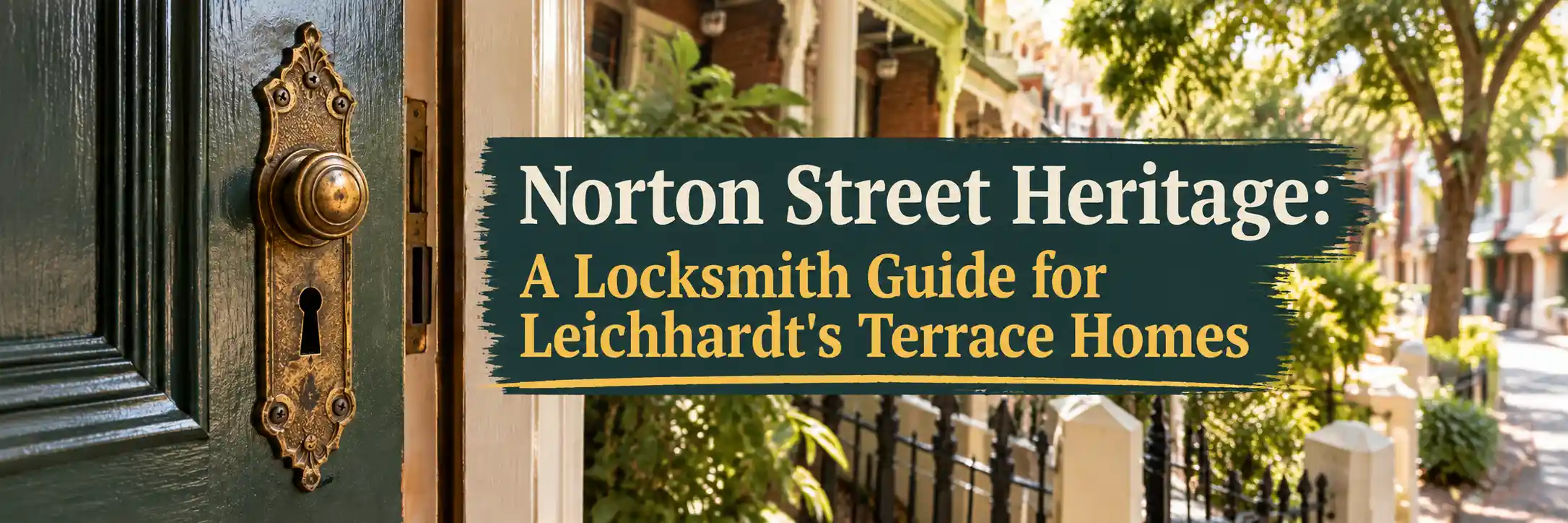
Leichhardt’s residential character is defined by its terrace homes — the federation and Edwardian terraces that run along the streets behind Norton Street and through the suburb’s grid, with their period facades, high ceilings, polished timber floors, and the ornate pressed-tin details that make them among Sydney’s most architecturally distinctive Inner West properties. Heritage lock Leichhardt terrace owners need to understand is a conversation about the gap between the character that makes these homes valuable and the security standard they actually provide. That gap is real, addressable, and doesn’t require replacing anything that makes the property distinctive.
The Leichhardt Terrace Lock Landscape
A Leichhardt terrace built between 1890 and 1920 has entry hardware from a different era. Understanding what’s actually there — before making any decisions about what to change — is where every useful conversation starts.
The front entry typically has a mortice lock. The mechanism lives inside the door body rather than through it.
The external face shows an escutcheon plate — usually brass, sometimes with decorative detailing that matches the door furniture. The key operates levers inside the case that engage the deadbolt. This is a fundamentally different mechanism from the cylindrical deadbolt on modern doors, with specific security implications that flow from both the mechanism type and its age.
The Leichhardt terrace-specific context. Leichhardt’s terrace rows are party-wall construction — each home shares walls with its neighbours on both sides. This simplifies the security perimeter: only the front facade and the rear of the property are accessible from outside. The front faces a residential street with the natural surveillance that active terrace-lined streets provide. The rear faces either the private garden or, in properties with rear lane access, the lane running behind the terrace row.
Original vs updated hardware. Leichhardt terraces have been through various phases of ownership and renovation. Some have original hardware from construction; others have been partially updated — a modern cylinder fitted into an original mortice case, or a contemporary deadbolt added alongside original furniture. Understanding which applies to a specific property requires looking at the actual hardware, not assuming from the door’s appearance.
What Makes Period Hardware Riskier
Leichhardt’s original terrace lock hardware was designed to the security standard of its era — which predates modern security engineering by a century. The specific vulnerabilities:
Lever mechanism pickability. Original lever-type mortice locks use levers that must be lifted to a specific height by the key. These mechanisms are pickable with basic tools and knowledge by anyone who’s spent an afternoon learning. The pin-tumbler cylinders fitted to modern locks use a more complex, more attack-resistant mechanism.
Short bolt throw. Original mortice bolts often throw only 12–15mm into the strike plate. Modern security standards specify a minimum 25mm throw. A shorter bolt means less pry distance is needed to clear the strike plate — the door becomes easier to force with mechanical leverage.
Mechanism wear. A lock that’s operated daily for 80–120 years has worn components. Levers with rounded edges, springs with reduced tension, a bolt that doesn’t throw fully — wear reduces security in ways invisible from the outside and unmeasurable without disassembly.
Strike plate vulnerability. Original strike plates in Leichhardt terraces are often secured with short screws into the surface timber of the door jamb. These provide significantly less resistance to forced entry than a reinforced plate anchored into structural framing behind the jamb.
Pro Tip:
Before any lock hardware decision in a Leichhardt terrace, probe the timber around the existing lock hardware and strike plate with something firm — a screwdriver. Push firmly at the frame around the strike plate position and around the lock case. Soft, spongy, or crumbling timber is common in period homes that have absorbed moisture over a century. Hardware fitted into damaged timber provides the security of damaged timber, regardless of its own quality. Address the timber before upgrading the hardware.
The Cylinder Upgrade: Maximum Security Gain, Zero Heritage Impact
For Leichhardt terraces whose mortice locks accept a removable cylinder — and many do, particularly those that have been partially updated at some point — the cylinder upgrade is the most impactful single security improvement available. It changes everything functional while touching nothing visible.
A modern high-security cylinder in an original mortice case provides:
- Anti-pick pin configurations that defeat standard picking tools
- Anti-drill hardened steel inserts protecting the cylinder core
- Anti-bump protection through security pin variants
- Restricted key blanks — available only through the authorising locksmith, not at any hardware store
The external escutcheon plate stays. The original brass furniture stays. The period character of the door stays completely intact. The mechanism that determines how the lock responds to attack: completely updated.
The measurement that matters before purchase: the cylinder dimensions. Leichhardt terrace mortice locks come in various configurations developed over construction eras. A replacement cylinder needs to match the existing case dimensions — particularly the cam length at the back that operates the lock mechanism. A locksmith who works regularly with Leichhardt’s heritage stock will measure before recommending, not after purchasing.
What the Cylinder Upgrade Doesn’t Fix
Honest assessment of what a cylinder upgrade addresses and what it doesn’t:
The bolt throw length. A cylinder upgrade changes the attack-resistance of the cylinder itself. It doesn’t change the bolt throw length of the underlying mortice mechanism. A lock with a 12mm bolt throw has a 12mm bolt throw regardless of cylinder quality. Addressing this requires either servicing or replacing the mechanism — which means removing the original hardware.
Glazed panels adjacent to the entry. Many Leichhardt terraces have fanlight windows above the entry door or sidelights beside it — sometimes original leadlight, sometimes clear glass in a period timber frame. Glass within arm’s reach of a deadbolt is an entry point that no lock quality addresses. Breaking the glass and reaching through to the internal turn takes fifteen seconds. Options: security film that holds glass together after breakage, or acceptance that the glazed panel is the vulnerability rather than the lock.
Mechanism wear. A cylinder upgrade in a worn mechanism produces the security of a worn mechanism with a better cylinder. Service the mechanism — confirm the bolt throws correctly and fully — before or alongside any cylinder upgrade.
“Leichhardt terraces are where we do our best heritage work. The homes are beautiful, the owners care deeply about them, and the upgrade path is genuinely straightforward in most cases. The original escutcheon stays, the original door furniture stays, a new cylinder goes in, the strike plate gets reinforced behind the original plate, and the back door gets a deadbolt. The house looks exactly as it did. The security standard is current. That’s the outcome every Leichhardt terrace can achieve.”
The Strike Plate: Leichhardt’s Most Overlooked Security Upgrade
If one upgrade produces the most security return for a Leichhardt terrace, it’s the strike plate — not the cylinder. Original strike plates in period terrace homes are typically:
- Secured with two or three screws of 25–35mm length into the surface timber of the door jamb
- Often corroded, painted over, or with screws that no longer have reliable grip after decades of paint cycles
- Positioned to accept the mortice bolt without the depth to resist sustained mechanical force
A reinforced strike plate — a heavier gauge steel unit with extended screw positions — anchored with 75mm or longer screws that pass through the jamb and into the structural framing behind it, changes the fundamental physics of a kick-in attempt. The force distributes into the house’s structural frame rather than relying on short screws in a hundred-year-old timber jamb. In Leichhardt’s solid hardwood-framed terrace construction, properly anchored strike plates perform exceptionally.
The visual impact: none. A reinforced strike plate behind the original cover plate, with longer screws through existing holes, is invisible from the front of the door.
The Rear Entry: Where Leichhardt Terrace Security Consistently Gaps
Leichhardt terraces with rear lane access have a specific security dynamic. The back entry — accessible from the lane — typically has:
- A keyed lever handle with no separate deadbolt
- Hardware lighter than the front entry’s specification
- Timber frames with more moisture exposure from laundry proximity or garden irrigation
- Strike plates that may not be engaging the bolt correctly after years without assessment
The front door of a Leichhardt terrace gets attention because it faces the street. The back door faces the lane. The break-in statistics for inner-city terrace suburbs consistently point to rear entries — less observed, lighter hardware, less mental attention from the occupants. A quality deadbolt added to the back entry with a reinforced strike plate properly anchored is the security upgrade that most directly reduces actual risk for most Leichhardt terraces.
Warning:
Don’t assume that a Leichhardt terrace’s Crimsafe or security screen door at the front entry eliminates the need to assess the timber door behind it. A security screen provides meaningful resistance at the outer layer. The timber door behind it remains the barrier that would face any sustained attempt after the screen is defeated.
Both layers need to be assessed and appropriately upgraded — they work in sequence, not in substitution.
Heritage Overlay and Inner West Council
Leichhardt falls within the Inner West Council local government area, and many of its terrace streets are within heritage conservation areas or carry individual heritage listings. Before any visible external hardware changes — replacing an escutcheon plate, adding visible hardware to the street-facing facade — a brief confirmation of what the heritage overlay allows is worthwhile.
In practice, internal lock work — cylinder replacement, mechanism service, strike plate reinforcement — almost always falls below the threshold that triggers heritage approval. Changes to the visible external profile of a heritage-listed entry door may require heritage consideration. Inner West Council’s heritage advisors can clarify what applies to a specific Leichhardt property in a brief consultation.
The guiding principle that applies to most Leichhardt terrace security upgrades: preserve what’s visible and character-significant, upgrade what’s functional and determines security outcome. This principle aligns with both good heritage practice and good security practice in almost every case.
Conclusion
Heritage lock Leichhardt terrace owners navigate is a conversation about preserving what’s genuinely worth preserving while being honest about what isn’t performing adequately. The original brass escutcheon, the period door furniture, the character of a 1910 terrace entry — these are worth preserving. The lever mechanism inside the case that was designed to the security standards of 1910 — this is what the cylinder upgrade addresses, invisibly, without touching anything the street sees.
The result: a Leichhardt terrace that looks exactly as it should and performs at a security standard appropriate to its value and its occupants. That outcome is available for every period terrace in the suburb.