
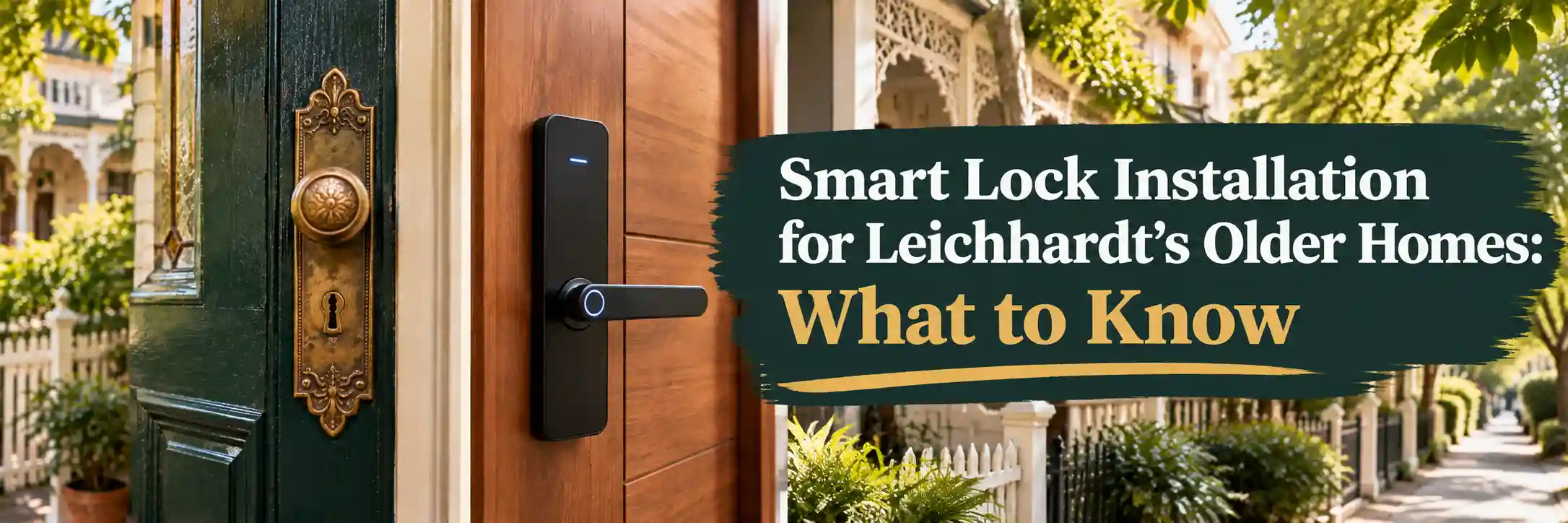
Leichhardt’s terrace and semi-detached stock is among Sydney’s most distinctive residential architecture. It’s also among the most technically challenging for smart lock installation. Smart lock Leichhardt older home compatibility is a question that starts before any product is selected — because the doors on Leichhardt’s period properties were built to specifications that predate the consumer smart lock market by a century, and the mismatch between product assumptions and physical reality is where the majority of installation problems originate.
This guide covers the honest assessment: what’s compatible, what isn’t, and what to check before any hardware is purchased.
Why Leichhardt’s Period Homes Create Specific Challenges
Consumer smart lock products are designed around an assumed door. That door is typically 35–45mm thick, pre-drilled in standard positions for cylindrical hardware, square and plumb in its frame, and fitted with a cylindrical deadbolt that the smart lock directly replaces.
A Leichhardt terrace door built in 1905 shares almost none of these characteristics:
- Door thickness. Federation and Edwardian terrace doors are solid hardwood throughout, often running 45–55mm thick or more. Many consumer smart locks specify a door thickness range that these doors exceed.
- Lock type. The standard hardware in a Leichhardt period terrace is a mortice lock — built into the door body rather than through it. Consumer smart locks replace cylindrical deadbolts; a mortice lock is a different interface entirely.
- Door squareness. A terrace door that’s been in its frame for a century has settled, swelled, contracted with seasons, and may require a particular closing technique to latch properly. A smart lock with auto-close or auto-lock functionality requires the door to close and latch reliably without assistance.
- Frame condition. Smart lock installation requires secure anchoring to sound timber. Period door frames with rot, borer damage, or paint-accumulated layers may not provide the substrate a smart lock needs.
None of these challenges make smart lock installation in a Leichhardt terrace impossible. They make the assessment conversation essential before any purchase decision is made.
Pro Tip:
Before purchasing any smart lock for a Leichhardt terrace or semi, have a locksmith visit the property to assess the specific door. This assessment takes about twenty minutes, costs very little relative to the price of a quality smart lock, and definitively answers the compatibility questions that product specifications alone can’t resolve. In Leichhardt’s period housing stock, assessment-before-purchase is the sequence that consistently produces better outcomes than purchase-before-assessment.
The Mortice Lock Question
The most common specific question from Leichhardt terrace owners: can a smart lock be installed where there’s currently a mortice lock?
The direct answer: not directly, with standard consumer products. Standard smart locks replace cylindrical deadbolts. A mortice lock is a different system that lives inside the door body and has a different interface.
The options that actually work for Leichhardt period doors:
- Mortice-specific smart locks. These exist — products designed to retrofit into mortice cases or to replace the mortice mechanism. They’re less common in the Australian market, typically more expensive, and require the existing mortice case dimensions to be assessed for compatibility before purchase. Not every mortice case accepts every mortice-specific smart lock.
- Smart lock on the rear entry if it has a cylindrical deadbolt. Many Leichhardt terraces have had their back entry updated at some point — a modern cylindrical deadbolt added to the back door even if the front remains original. A smart lock on this updated rear entry provides smart access management without touching the period front entry hardware. The front door keeps its original character; the rear entry provides the keyless functionality.
- Cylinder upgrade within the existing mortice case. If smart lock technology isn’t actually the goal but improved access management and key control are, a restricted-key cylinder upgrade in the existing mortice case solves the key control and duplication problems that smart locks also address — without any compatibility complexity. Less technology, significantly simpler implementation, fully compatible with period hardware.
- Smart lock with physical key backup on a secondary door. For Leichhardt terraces where a secondary entry has been modernised, this is often the most practical path: smart lock on the modern door, upgraded heritage cylinder on the period front, both working in the same keyed system.
When Smart Locks Make Genuine Sense for Leichhardt Properties
Despite the compatibility complexity, there are specific Leichhardt property and household situations where a smart lock delivers clear, sustained value:
Italian Forum apartments with modern entry doors. The Italian Forum complex includes residential apartments above the commercial piazza. These apartments have modern entry doors — not period terrace hardware — and are typically compatible with standard consumer smart lock products.
The strata check (below) still applies, but the hardware compatibility question is largely resolved by the building’s construction era.
Leichhardt terraces that have been through full renovation. Some Leichhardt terraces have been renovated to the point where the secondary entries have modern door systems — new rear extensions with contemporary doors, updated laundry entries, added side passages. Where these modern doors exist, smart lock installation is straightforward.
Share households with high-turnover residents. Leichhardt’s terrace stock attracts share household groups — professionals and younger residents who want Inner West proximity. A share terrace where housemates change regularly has the key management friction that smart locks address most effectively: individual codes per resident, no rekeying when someone moves out, no ‘did everyone return their keys’ question at end of tenancy.
Leichhardt investors managing rental properties. Investors with Leichhardt terrace rentals benefit from smart lock tenancy management — outgoing tenant codes deactivated, incoming codes issued, without physical key exchanges. For a Leichhardt landlord managing the property remotely, this operational efficiency is meaningful — provided the door and strata situation permits the installation.
“The Leichhardt smart lock questions are almost always the same conversation twice: first, is the door compatible — usually no for the original front entry, sometimes yes for a modernised back entry; second, is there a strata or heritage consideration — yes if the tenancy is in a managed building or a heritage conservation area. When both answers are manageable, we have a clear path. When either isn’t, we talk about the cylinder upgrade that achieves the same key management outcome without the compatibility problem.”
Strata and Heritage Considerations for Leichhardt Properties
Smart lock installation in Leichhardt’s properties intersects with two governance frameworks that require checking before any hardware is purchased:
Strata by-laws for any property in a strata scheme — apartments above Norton Street commercial premises, the Italian Forum residences, some of the newer multi-unit developments on the suburb’s streets. Strata by-laws often define entry doors as common property, or specify that visible hardware changes require owners corporation approval. A smart lock installation that changes the visible profile of a strata entry door may require OC approval before proceeding.
Heritage conservation area conditions for Leichhardt’s residential terrace streets. Many of the suburb’s residential streets fall within heritage conservation areas under Inner West Council’s planning framework. Visible external hardware changes on heritage-listed or heritage-adjacent properties may require council consideration. Internal changes — cylinder replacement, mechanism service — typically don’t trigger this. A smart lock that changes the visible face of the entry door may.
The practical check: confirm with the strata manager (if applicable) whether the entry door is common property and whether hardware changes require OC approval, and confirm with Inner West Council heritage advisors whether a smart lock installation on the street-facing entry would require assessment. Both checks are simple and inform the installation decision before hardware is purchased.
Warning:
For Leichhardt renters wanting a smart lock: this is a structural modification under the Residential Tenancies Act 2010 (NSW), requiring written landlord approval in addition to any strata or heritage consideration the landlord themselves may need to obtain. The process has multiple layers: tenant requests approval from landlord, landlord confirms with strata (if applicable) and heritage adviser (if applicable), written approval returns to tenant before locksmith is engaged. Plan the timeline accordingly — this is not a same-week installation in most cases.
What to Check Before Purchasing Any Smart Lock for Leichhardt
- Measure the door thickness at the lock position — confirm it falls within the smart lock’s specified range
- Identify the existing lock type — cylindrical deadbolt, mortice lock, or rim lock
- Confirm whether the door closes and latches reliably without assistance — prerequisite for auto-lock function
- Check for strata by-law conditions if the property is in any strata scheme
- Confirm Inner West Council heritage overlay status for the property
- For renters: obtain written landlord approval before ordering any hardware
- Have a locksmith assess the specific door — twenty minutes that prevents a product return
The Alternative That Always Works: Cylinder Upgrade
For Leichhardt terrace owners where smart lock compatibility proves complex, the high-security cylinder upgrade consistently delivers the key management outcomes that make smart locks attractive — without any of the compatibility questions.
A restricted-key cylinder in the existing mortice case:
- Prevents hardware store key copying — the blank isn’t available there
- Creates a documented key issuance record that can be managed like smart lock access codes
- Removes the rekeying cycle by eliminating undocumented copying as a possibility
- Is fully compatible with any period door, any mortice case, any terrace construction era
- Requires no strata approval for like-for-like cylinder replacement
- Preserves the heritage character completely
Conclusion
Smart lock Leichhardt older home installation is a question that requires an honest assessment of the specific door before it becomes a question about which product to buy. For Leichhardt’s period terrace stock, the assessment consistently reveals one of two paths: a compatible installation path (usually a modernised secondary entry or the Italian Forum apartments), or a cylinder upgrade path that achieves equivalent key management outcomes without the compatibility complexity.
Both paths produce better security and better key management than the status quo. The assessment determines which path is available for a specific Leichhardt property — and that assessment, done properly, costs less in time and money than returning a smart lock that turns out not to fit a century-old mortice door.